
Frequently Asked Questions
ISVA FAQ's: Going to Court
Going to court after experiencing sexual violence can feel daunting and overwhelming. This guide, created with insight from our Independent Sexual Violence Advisers (ISVAs), explains what the court process involves, what support is available, and what you might expect at each stage. It’s designed to help you feel informed and prepared, so that you can approach the process with clarity, confidence, and the knowledge that you don’t have to go through it alone.
Contents:
- Section 1: Court process
- Section 2: Pre-trial
- Section 3: Trial Day
- Section 4: Post-trial
- Section 5: Supportive messages
Section 1: Court process
Section 2: Pre-trial
What should I wear? toggle accordion content
Court is a formal environment so some people feel better dressed smart, but you can wear whatever you feel comfortable in. It can also be a good idea to wear layers, so you don’t feel too hot or cold at any point.
What are Special Measures? toggle accordion content
Special measures are adjustments that can be made to make you feel as comfortable as possible giving your evidence. There are 8 special measures in total, and they must be applied for and granted by the Judge. You can talk to your ISVA or Witness Care Officer about these and what you think would be best for you.
The 8 special measures are:
- Screens
- Video link
- ABE video
- s.28 pre-recorded cross examination
- Intermediary
- Aids to communication
- Evidence in private
- Removal of wigs and gowns
Who are Witness Care Officers? toggle accordion content
Witness Care Officers (WCOs) work for the police, but they are not police officers. Your WCO will be the person to apply for special measures for you and put forward any requests to the court. They will also be the person to tell you what day and time you will need to attend court, once this is confirmed. You can ask for your WCO to pass any information and updates to you through your ISVA if you have one, if you would prefer not to be contacted directly by them.
Who are the Witness Service? toggle accordion content
The Witness Service are part of Citizens Advice and are based at all courts across the country. They are staffed by volunteers who can show you around a court ahead of the trial date (a pre-trial visit) and will be there on the day you attend court to give evidence as well. They are there to help support you and answer any questions you may have.
Can I bring supporters? toggle accordion content
Yes, you can bring a friend or a family member and a professional supporter like your ISVA, it’s up to you. Lots and lots of supporters may not be allowed, but one or two is fine.
When will I have to go to court? toggle accordion content
You must go to court when the trial date has been set, and you’re told it’s time to give your evidence. This may not be the first day of the trial and you will only have to go on the day/s you are needed to give evidence. You will know when to go as you will hear from your Witness Care Officer, your ISVA if you have one, and/or your police officer.
How do I get to court/where do I park/what about transport costs? toggle accordion content
How you get to court depends entirely on what you feel most comfortable with. Most courts are near a train station or on a bus route, but both your ISVA if you have one, and Witness Care Officer will help you with figuring this out. You may prefer to drive, which is absolutely fine. Speak to your ISVA or Witness Care Officer about local car parks near the court. However you choose to travel, your transport costs will be covered by the courts, so remember to keep all your receipts so you can claim the money back for your journey.
Who can I speak to and what can I speak to them about? toggle accordion content
You will be classed as a witness in the case, and as a witness you are advised not to speak to other witnesses about the case. You are allowed to speak to other witnesses in general, as they may be your family and friends, who are your support network. However, it would be best if you do not speak about any evidence you are going to give, or the specific details of the case with anyone. This will include if your trial is over several days, and you give evidence on the first day. The Judge will advise you not to speak to any other witnesses about what happened in court. Any communication from the defendant should be reported straight away to the officer in charge of your case.
What court will I go to? toggle accordion content
The trial will be heard in a court in the area where the crime took place. So, for example, if the crime occurred in Sussex, and Sussex Police have been investigating your case, your trial will be in Sussex. There are a few courts over Sussex, and it can depend on court availability as to which court your case is heard at. A certain court can’t be requested. The courts in Sussex are; Lewes, Hove, Brighton and Chichester. You will find out which court you case is being heard at the week before the trial.
What happens if my trial is delayed? toggle accordion content
Sometimes trials can be delayed. You could be told about this before the trial date and a new date given, or it could be just a few days before or even the day of the trial. There are lots of different reasons why a trial may be delayed including a courtroom not being available, a previous trial over-running, or the barristers saying they’re not yet ready to go to trial. If your trial is delayed a new date should be set as soon as possible, although this could be a few months down the line.
Do I need to get my own legal representation? toggle accordion content
No. You don’t need your own barrister, as you will be considered a witness for the prosecution case, which is brought by the Crown Prosecution Service, acting on behalf of the state. The Crown Prosecution Service Solicitors will hand the case over to a barrister to deliver you case to the court. The barrister who presents your case to the court, will normally introduce themselves on the day you are due to give your evidence.
Section 3: Trial Day
Arriving at courttoggle accordion content
As a survivor of a serious crime, you can enter the court building via a discreet side entrance specifically for witnesses, rather than using the main entrance. This is referred to as the ‘witness entrance’. Your ISVA can arrange this for you, or you can arrange it with the police. Whether you use the witness entrance or the main entrance, you must go through security every time you enter the court building. This means your bags will be searched and you will be scanned with a handheld or archway detector. Certain items are not allowed to be brought into the court room – a list of these can be found here. You may be asked to prove that any liquids you bring in are not harmful, i.e. by using hand sanitiser or sipping your drink in front of security staff. Medicines are permitted if they have the pharmacist’s label. Any items you are not allowed to take in will be held by the security officers and you will be given a receipt so these can be returned to you later.
How should I address the Judge/barristers? toggle accordion content
Court is a formal environment, and judges are referred to as ‘Your Honour’. It’s unlikely you’ll need to address the Judge directly, so don’t worry too much, but you may hear other people calling them this. Your barrister will introduce themselves to you before you give evidence, and you can go by what they say. Usually, they will tell you their first name but sometimes it will be their surname for example ‘Ms Smith’.
Can I have someone sit with me while I give my evidence? toggle accordion content
We can ask the court for your ISVA to sit with you in court or in the video link room while you give your evidence, and the Judge will make the decision. Your ISVA won’t be able to talk to you but can be there as a supportive presence. If your ISVA is not available, or you don’t have an ISVA, you can ask someone from Witness Service can sit with you instead.
What is a jury? toggle accordion content
A jury is made up of 12 members of the public who get selected at random from the electoral register to sit on a jury. Their role is to listen to all the evidence and decide together at the end whether they think the defendant is guilty or not guilty.
How long will I be at court? toggle accordion content
The trial can take a few days or a couple of weeks to hear all the different witnesses and their accounts; however, you do not have to be there for the whole trial. You are only required to be there for the time it takes to give your evidence/ your account. If you decide to stay longer that’s your choice but not necessary, so it’s up to you. It is important to be aware though, that if you do decide to watch the rest of the trial, it may not be possible to have a retrial in the event there is a hung jury as you will have heard all the evidence in the case. This is something to think about when deciding whether to watch the rest of the trial or not, as well as the fact it might feel quite difficult to hear some of the things being discussed.
What can I take into court (own bible, fidget toy, support animal)? toggle accordion content
Anything like the above that you feel will help you and reassure you. If it is something small like a fidget toy or a crystal to hold in your hand then you don’t usually need to ask permission but if it is something bigger like a support animal, then the Judge will have to decide whether they will allow it or not. Your ISVA can provide you with a court bag with some useful bits to take into court, but also to keep you busy in the waiting room while you’re waiting to go into court, for example puzzle books, fidget toys and essential oils.
Who will be in the public gallery? toggle accordion content
The public gallery is open to everyone. The defendant’s supporters, if there are any wanting to attend, tend to be prioritised as they are the person on trial. You can have supporters in the public gallery too but just be aware that they may be sat near the defendant’s friends and family.
Will there be journalists/press? toggle accordion content
There might be journalists at your trial, especially if it’s a public interest case, but you will never be mentioned by name in anything that is reported. Survivors of sexual violence have lifelong anonymity so the press are not allowed to report anything that might identify who you are. It’s worth talking to your ISVA, SOIT Officer and/or Witness Care Officer if you are worried or need further information around this.
Section 4: Post-trial
Can I be reimbursed for expenses? toggle accordion content
Yes, is the simple answer. Keep all receipts and ask for an expenses form from the Crown Prosecution Service when you are at court. You can receive expenses costs for travel to court, accommodation (if it has been required for you to stay somewhere overnight), and food if you are there over lunchtime. You can also claim expenses for travel to and from your pre-trial visit if you had one.
What are the possible outcomes of the trial? toggle accordion content
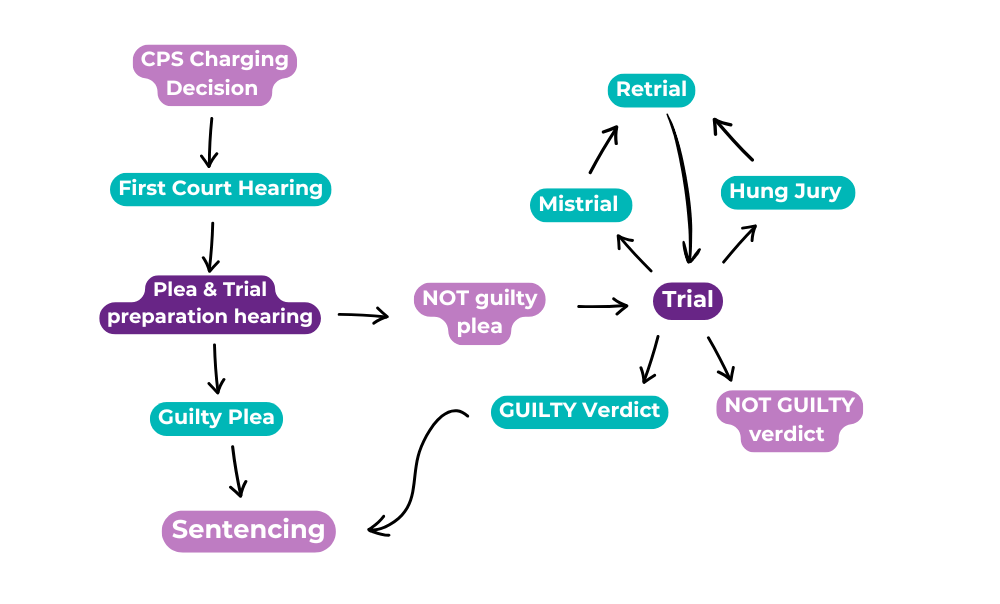
Once all the evidence has been shared at the trial, the Jury will go out to make a decision. Usually, the Judge will ask for a unanimous verdict which means for all 12 members of the jury to agree on the same outcome but sometimes they will allow a majority verdict of 10-2 or 11-1. The jury can reach the verdict of guilty or not guilty. If there are a few charges against the defendant, then the jury may come back with a mixture of guilty on some charges and not guilty on others. If the defendant is found guilty on any or all the charges then they will be sentenced, usually at a later date, but if they are found not guilty on all charges then that is the end of the trial, and nothing further will be done. Sometimes, the jury can’t decide, even if the Judge says they will accept a majority verdict over a unanimous one. This is called a ‘hung jury’ and means there will likely have to be another trial with a new jury. Sometimes before the trial is completed it may have to stop for various reasons. This is called a mistrial and will also mean it will go to a retrial.
Who will inform me of the outcome of the trial? toggle accordion content
You can decide how you would like to be informed of the outcome of the trial. If you want to be there yourself or watch it over a video link, this can be arranged however you never know when a jury will come back so it can be a lot of waiting around. The officer in charge of the case will be at court for the verdict and so you can ask them to call you to let you know, or you can ask for your Witness Care Officer, SOIT officer or ISVA to be updated and be the person to inform you if you’d prefer.
When will the sentencing happen? toggle accordion content
Depending on court availability, sentencing can happen immediately after the verdict or can be sometime after. If the sentencing is at a later date, you can attend if this is something you would like to do.
What is a Victim Personal Statement (VPS)? toggle accordion content
A VPS is a statement you can write to explain the impact the offence, investigation and trial has had on you. Rather than explaining what happened to you like you did at trial, it is an opportunity for you to explain the impact everything has had on you, and it can also have an impact on the sentence given. If the defendant is found guilty, then it can be read out at the sentencing for the court to hear. You can read it yourself if you’d like to and you are able to apply for special measures to be able to do this, or you can ask the barrister or someone else to read it for you. Once you’ve written it and given it to the police, you can’t change it but you can add to it or write an additional one if you’d like to. If you’re unsure about what to write or where to start, your ISVA can give you a prompt sheet with a few questions that might help you think about what you’d like to include.
Section 5 – Supportive messages
“I’ve sat beside a lot of survivors while they’ve given evidence at court. While the experience itself can feel so destructive and you may feel so vulnerable at the time, I can assure you that those survivors are some of the strongest people I have ever had the privilege to meet.
Whatever decision you make: to go to court, to not go to court; to challenge an NFA decision, or not; to report to the police, or not: please know that we believe you and you are worthy of yours’ and others’ care and compassion.
Remember that by doing what you are doing, you are helping the fight for change. You are not just a statistic; you are part of a movement. Every one of us that goes through the system is helping to put pressure on the government to recognize the extent of the problem.
Whatever the outcome or verdict, keep going, it doesn’t define you.” – Survivors’ Network CJ ISVA