
Blog | 01 September 2026
Survivors’ Stories: Reclaiming My Voice Through Art by Lisa Chester-Linskey
Trigger warning: This story contains references to sexual assault, sexual violence, victim-blaming, trauma, bullying, online abuse and the criminal justice system. Some details may be distressing or triggering for readers. Please take care of yourself and step away from the story if you need to.
In this instalment of our Survivors’ Stories series, we share the story of artist Lisa Chester-Linskey, whose experiences of sexual violence have profoundly shaped both her life and her creative practice.
Lisa’s story is one of survival, resilience and reclaiming her voice.
Art has been a quiet constant throughout my life. From an early age, I knew I wanted to be an artist, although it was dance that first gave me the opportunity to explore the world. I travelled extensively, working as a showgirl and magician’s assistant in circuses across the UK, Malta and Japan. Living and working in such different places exposed me to new cultures, people and perspectives, experiences that have continued to shape the way I see and create.
Creativity also became the thread running through my working life. I found myself drawn to roles where I could use it to connect with people: teaching baby sign language, delivering drama to children with ASD, entertaining at children’s parties and running singing groups for babies, toddlers and their families. I also worked in care homes with people living with dementia and Alzheimer’s, using music to create moments of connection between residents and the families that attended my classes. Despite the variety, the purpose was always the same -to bring people together and create a sense of belonging.
Then the pandemic brought that life to a sudden halt. The people I worked with were among those considered most vulnerable, and overnight the communities I had spent years building relationships with became inaccessible. With my work gone and my children at home, I had time to reflect on what mattered to me. Instead of dwelling on what I had lost, I began asking myself what might still be possible.
The answer was something I had wanted since childhood: art.
After lockdown, I returned to college in Hastings and completed an Art Foundation course, graduating with a distinction. One of my tutors encouraged me to aim higher and apply to Central Saint Martins. I never imagined I would get in, particularly as a single parent with mobility issues living in Hastings, but somehow I made the journey work.
Arriving at CSM was a dream come true. Yet being a mature student surrounded by highly talented artists, with an abstract style of my own, I initially felt like an imposter. Slowly, though, I found my feet. I worked hard, my confidence grew and I began to believe that perhaps I really did belong there.
Then, in Easter 2023, at the age of 49, my life changed again. A friend and neighbour sexually assaulted me. When I reported him, the response from much of my community was not support but hostility. I was ostracised, bullied and called a liar, while those around me chose to believe him. The case eventually reached Crown Court, where, despite nine of the twelve jurors believing my account, he was acquitted.
The impact was devastating. I became isolated and struggled to function creatively. I returned to university hoping that making art would give me somewhere to escape to, but instead I would sit in my studio unable to make anything. When I did manage to create, the work became increasingly dark, mirroring what was happening inside me. After my second year, I deferred my studies for a year to try to process the trauma and work through the anger, hurt and resentment.
That year brought further trauma. I experienced two more sexual violations, both by men I knew. I reported the assaults, but once again I felt profoundly failed by the systems that were supposed to protect me.
Something shifted when I eventually returned to university. I stopped trying to make art as a way of escaping what had happened and began to see its potential as a way of confronting it. Art became my means of processing the unspoken, reclaiming my voice and removing the shame that had never belonged to me in the first place.
My practice began to centre on sexual assault, abuse, consent and our relationship with touch. I wanted to move beyond telling only my own story and create work that could speak for others too, because sexual violence does not discriminate. It can affect anyone, regardless of age, gender, ability, religion, colour or background.
This led me towards tactile and interactive work, particularly exploring consent and permission to touch. I wanted some of my less explicit work to be accessible to children, people with visual impairments and people with special educational needs, using touch alongside sight to make the experience more engaging – and hopefully more memorable and impactful.
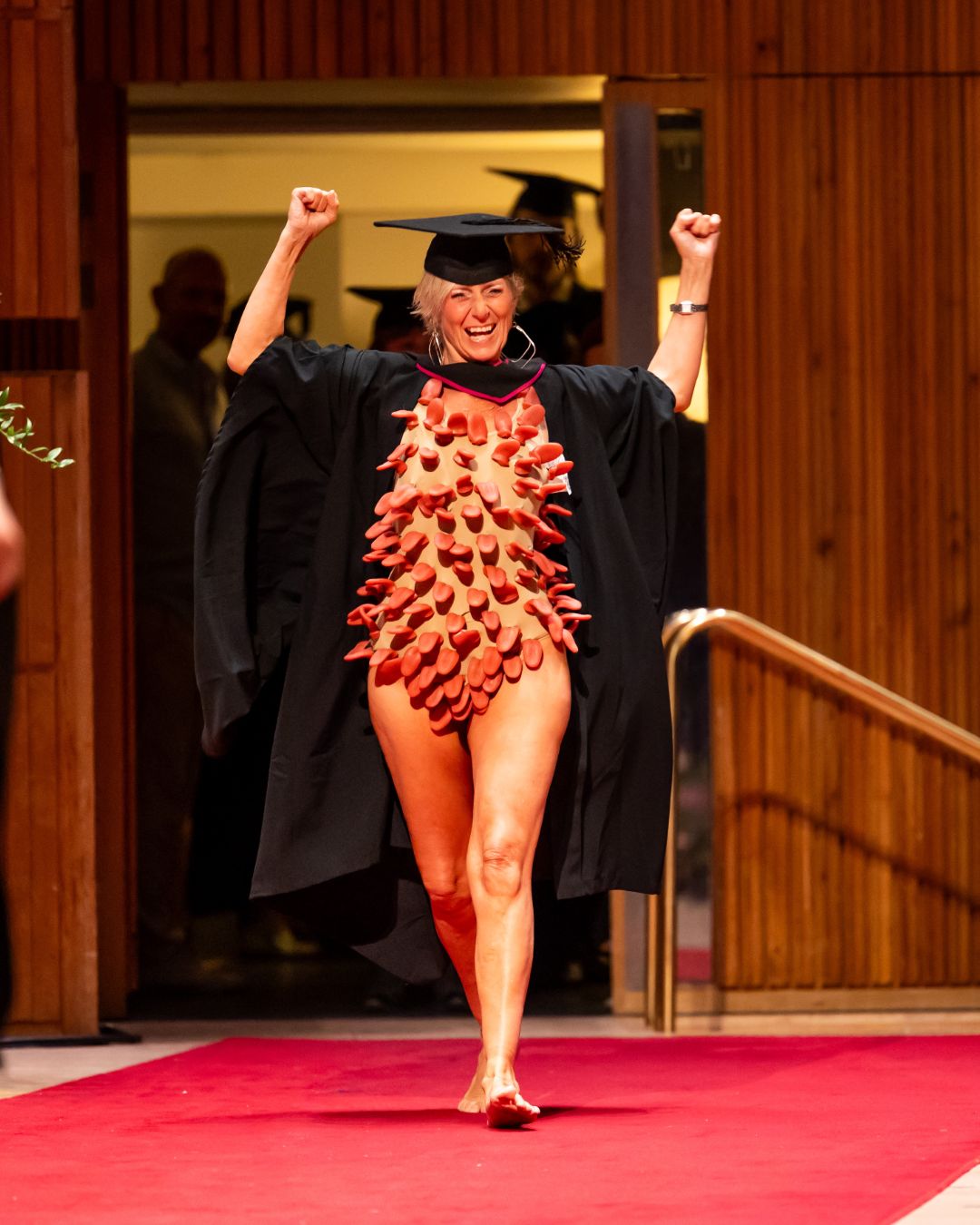
One of the most personal pieces I created was Get the Tongues Wagging (2026). The wearable artwork grew as a direct result of the assault by my neighbour. It also represented the gossip and rumours that followed. Hundreds of flesh-coloured tongues cover the piece, moving and wagging as I walk. It is deliberately uncomfortable to look at, because the subject itself is uncomfortable.
I had intended to wear it at my degree show, but circumstances changed. Instead, I wore it to my graduation at the Royal Festival Hall in July 2026, beneath my cap and gown. For me, it was far more than a piece of performance art; it was a statement. It was an act of taking back something that had become associated with fear, humiliation and shame.
When CSM shared a video of the performance, the work went viral and just 5 weeks after the video was shared, it had had 28 million views and over 130,000 likes. I was incredibly proud to be named CSM’s ‘Winner of Originality’, but the exposure also brought a barrage of online abuse, from racist and political attacks to deeply personal insults.
I can live with that.
I no longer see myself as a victim. I am a survivor. My work allows me to reclaim my confidence and power, and to take the shame that was wrongly placed upon me and return it to where it belongs - with the perpetrators. If that makes some people uncomfortable, so be it.
Perhaps discomfort has a purpose. Perhaps it is what makes us stop, look and talk about the subjects we would otherwise avoid.
As a child, when I considered wanting to be a vet, I thought being a vet would be too emotional for me. I could never have imagined that becoming an artist would take me somewhere far more emotionally challenging.
But it has also brought me back to where I always wanted to be.
My sense of purpose has returned. Through my art, I am once again using creativity to connect people, build supportive communities and create spaces for conversations that need to happen. Most importantly, I have found my voice – and I am no longer afraid to use it